
Commercial Cleaning Supplies: What Facilities Actually Need
Commercial cleaning supplies are easier to manage when they match the work happening in each part of a building. A facility manager can start with the tasks, surfaces, dispensers, access rules, and service scope, then decide what belongs in daily-use, restroom, floor-care, and specialty categories. This approach avoids treating a generic shopping list as a cleaning plan. It also makes it clearer who buys, stores, checks, and replenishes each item.
Request a free, scoped cleaning quote
What should a facility supply plan answer?
A useful plan answers a handful of practical questions for every category of material. What task does it support? Where is it used and stored? Which surfaces or dispensers must it fit? Who approves and purchases it? Who checks the remaining stock? What should staff do if the item is missing, damaged, or no longer approved?
Write the answers down in a shared inventory or operating document. A plan that only one person understands can fail when that person is away, a shift changes, or an area is renovated. The record does not need to be complicated. A spreadsheet, printed checklist, or facility inventory system can work if it stays current and the people responsible can find it.
Begin by separating cleaning materials from occupant consumables. Cleaning materials support the task: tools, cloths, approved products, and equipment. Occupant consumables replenish dispensers or waste stations: for example, compatible paper goods, soap refills, and liners. Those groups may have different purchasing owners, storage requirements, and reorder routines. Mixing them in one undifferentiated count makes shortages harder to diagnose.
Janitor Utah describes customized commercial and janitorial schedules, from once a day to once a month. The work and supply responsibilities should therefore be agreed for the specific facility instead of inferred from a standard list. Review the commercial cleaning information and janitorial cleaning information when identifying the scope to discuss.
How do you map tasks before choosing supplies?
Walk the building before ordering a new set of products or reorganizing a closet. Do not start with a catalog. Start with a route and a task list. Record the spaces that need routine attention, who uses them, and what kind of work is expected there. The point is not to write a cleaning procedure from memory; it is to identify the decisions that affect the supplies and responsibilities.
- List the spaces. Include reception, work areas, meeting rooms, corridors, restrooms, break areas, storage rooms, and any restricted or specialized areas. Identify multiple floors or suites separately when they have different access rules.
- Mark the surfaces and fixtures. Note floor types, counters, glass, touchpoints, bins, dispensers, and any finish or equipment that requires a specific method. If you do not know a material or finish, identify who can confirm it before a product is assigned.
- Record recurring tasks. Separate routine dusting, waste collection, restroom service, spill response, and scheduled floor care from one-time or periodic project work. A periodic task should not silently become a daily supply assumption.
- Identify the people doing the work. Mark tasks assigned to facility staff, cleaning staff, or another approved role. Make clear when staff should report an issue rather than handle it themselves.
- Note constraints. Record hours, access limits, security procedures, storage limits, areas that must remain clear, and any facility-specific approvals needed before work begins.
- Connect each task to an item or decision. Add an item only when the task and applicable procedure call for it. If the correct product or tool is not yet known, list the question rather than guessing.
This walk-through helps prevent two common problems: over-ordering products for tasks outside the scope and discovering that a supposedly suitable item does not fit the surface, dispenser, or site procedure. It also creates a useful baseline. If the work changes later, the manager can compare the new tasks with the original map and update only the affected categories.
For instance, a professional office might have daily waste collection in shared areas, scheduled restroom checks, occasional attention to conference rooms, and periodic carpet care. That does not mean every employee should purchase or handle every product. The manager can mark which routine tasks are assigned to the cleaning arrangement, which consumables remain facility-owned, and what needs separate approval. The example illustrates planning, not a standard Janitor Utah package.
What belongs in a daily-use supply zone?
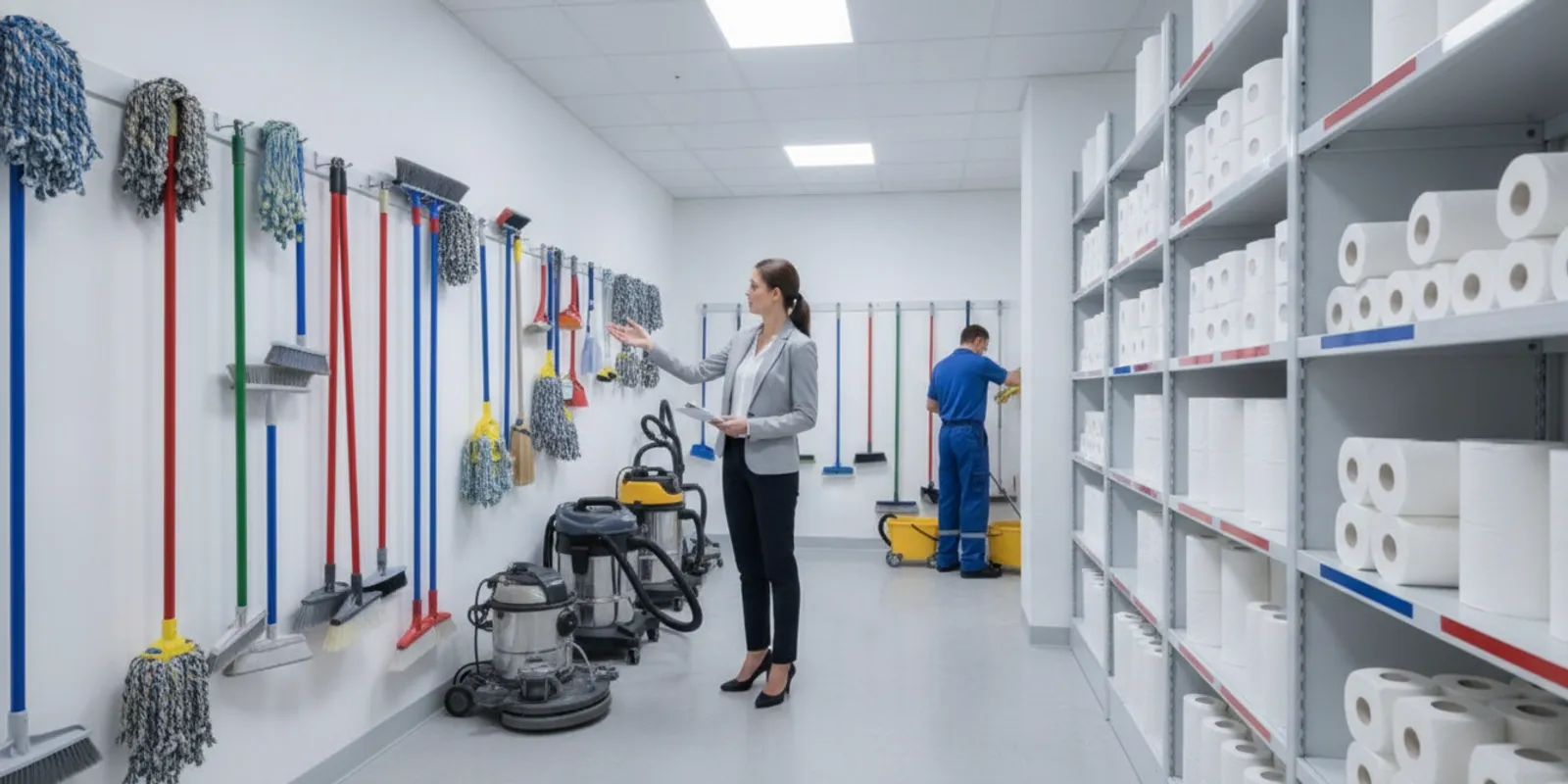
Daily-use supplies support the work performed on regular routes. Keep them convenient for authorized staff, but organize them by task rather than placing every item together without distinction. The exact contents should follow the written scope, approved procedures, and surfaces at the site. A list of possible categories is a planning prompt, not a product recommendation.
- Reusable tools: Identify where cloths, dusting tools, mop heads, and other reusable equipment belong. If site procedures separate tools by area or task, make the separation visible and easy to maintain.
- Waste-handling materials: Check the bin sizes and types in the route, then record the liner styles or collection tools the facility actually uses. Note whether special waste streams have distinct procedures.
- General surface-care materials: Keep an approved-product list tied to the surfaces for which each item is intended. Do not assume one product works on every counter, finish, fixture, or piece of equipment.
- Spill-response arrangements: Identify where authorized staff find the materials and instructions appropriate to routine spills, and who they notify when an incident falls outside routine cleaning.
- Protective items and instructions: Record where required protective items are kept and which role is expected to use them. Follow labels and workplace procedures rather than improvising a new method.
Give frequent-use items a clear home. A shelf map can name the item, the task, the storage location, and the person or role responsible for checking it. Use plain descriptions that a new team member can follow. If the facility changes brands or packaging, update the record instead of leaving an old label or instruction in place.
Make sure the storage arrangement suits the work, not just the inventory. Keep walkways, exits, panels, and equipment access clear. Place items so staff can return them without moving unrelated stock. Where a building has several closets, decide whether each location needs its own working quantity or whether a central storeroom supplies smaller satellite areas. Record where backstock lives so a worker does not mistake an empty local shelf for a facility-wide shortage.
How should you plan restroom consumables and cleaning materials?
Restroom planning combines two related but separate systems. Cleaning materials and tools support the work. Occupant consumables replenish the dispensers and bins. Track both, but do not merge them into a single count. A restroom can have enough cleaning products and still run short of a compatible refill, or have plenty of consumables but no one assigned to check them.
Start with a fixture-by-fixture record. List each restroom, the number and type of dispensers, the refill format each one accepts, and the bin or liner arrangements. Record accessible or staff-only areas separately if their access differs. For multiple suites or floors, use names people recognize, not vague labels such as “back restroom.” The objective is to make each stock check traceable to a location.
- Walk each restroom and record dispenser type and location. Do not order refills based only on a remembered brand or a description from another site.
- Determine who owns each category: facility purchasing, a designated onsite role, a cleaning provider, or a shared arrangement written into the scope.
- Set a check interval that reflects observed use, the facility schedule, and delivery timing. Check more often if the facility has a known peak or a recent change in occupancy.
- Choose a suitable backstock location and mark which items are allocated to each building or floor when several locations share inventory.
- Record shortages, dispenser problems, and unusual consumption. A repeatedly empty dispenser may signal a refill issue, a usage change, or a check routine that is too infrequent.
Consider a multi-tenant office as a worked example. The property manager may own the purchase of paper products, while a cleaning team checks and refills dispensers from designated backstock. If so, the written scope should state which refills are included, where they are stored, who reports a low quantity, and whether the cleaner may substitute a different product. Without those details, the manager may assume that purchasing includes restocking while the service team assumes the opposite.
Compatibility is as important as quantity. A storeroom can appear well stocked but still lack the refill that fits an installed dispenser. If a dispenser is replaced, update the inventory record and use up or remove the old stock through the facility’s approved process. Avoid transferring a product to an unmarked container to make it fit the shelf or to simplify dispensing.
The services overview can help frame a discussion about which areas and types of work a facility wants to include. It does not establish that any particular refill, product, or supply responsibility is automatically included in a service arrangement.
How do you organize floor-care supplies by surface?
Floor-care planning begins with a simple floor map, not a broad product category. A commercial site may have carpet, resilient flooring, tile, concrete, or more than one finish in close proximity. Identify the material or finish in each area, then connect it to the approved routine and the person responsible. If the surface is unknown, pause and confirm it before assigning a product or method.
Separate routine maintenance from periodic work. Removing loose debris or responding to a small spill is not the same assignment as scheduled carpet care, floor finishing, or a project after construction. For each activity, note the area, expected frequency, access window, approval owner, required equipment, and whether the equipment comes from the facility or the service provider. Do not treat a tool in a closet as proof that a task has been authorized.
Imagine a business with carpeted offices, hard flooring in the lobby, and tile in a break area. A useful plan names each zone and tells authorized staff where the approved task instructions are kept. It does not tell them to use one general-purpose cleaner everywhere. If a furniture move, renovation, or floor replacement changes the surface, the map and supply assignment should be reviewed before the next service cycle.
Follow the manufacturer’s instructions for the floor and the product, along with facility requirements. Keep products in their original labeled containers and do not mix chemicals unless the label expressly directs it. Keep the list of approved materials current and accessible to people doing the work. Remove obsolete directions when an item, surface, or procedure changes. The Occupational Safety and Health Administration provides workplace safety and hazard communication resources on its official website; facility procedures and current product labels remain important for site-specific decisions.
For a periodic floor-care job, record who authorizes it and how the area will be made available. Confirm whether furniture, equipment, or workstations need to be moved by facility staff. Note any access or timing restrictions and who communicates them to occupants. These coordination details often matter as much as the supply itself because a suitable tool cannot be used effectively if the area is not ready or the task is not in scope.
When should specialty supplies be planned separately?
Specialty work deserves its own planning and approval rather than being treated as an extension of a general janitorial closet. Examples might include post-construction cleanup, work in an industrial or warehouse area, a disinfection request, or a periodic floor or carpet project. Each may involve different surfaces, site rules, materials, access, and timing. A familiar product list does not establish that a specialty task is authorized or properly equipped.
For each specialty need, write a brief job description before gathering supplies. State the area, the requested result, the timing, the surfaces or fixtures involved, and any operational restrictions. Identify who approves the work and who can confirm product or method suitability. If the activity is outside the routine scope, agree on the method, responsibilities, and storage plan in advance. Keep the record with the job rather than making a permanent change to everyday stock without review.
Post-construction cleanup is a useful example of why this distinction matters. A site may have dust and debris, newly installed finishes, protected equipment, restricted work zones, and a schedule tied to other trades. Before the work, the manager can identify which spaces are ready, which remain active work zones, what must not be moved, and who gives access. The supply list then follows the agreed task and product directions. It should not be copied from a routine office checklist.
Janitor Utah markets industrial and warehouse cleaning, during-build and final construction cleaning, disinfection, and floor and carpet care. These are areas to discuss for a specific site, not a promise that a particular supply or specialty material is included in every agreement. See the industrial cleaning information and construction cleaning information for context on those types of work.
When a specialty request includes disinfection, avoid choosing a product based on a broad label or an assumed outcome. Confirm the intended use, surface compatibility, directions, and facility requirements before work is assigned. Do not describe a routine cleaning task as a guarantee of a health outcome. A clear written scope should state the work requested and the limits of what the facility expects.
How can you store supplies safely and keep the closet usable?
An orderly storage room supports both inventory control and consistent work. Keep products in original containers with labels intact, follow product directions and facility safety procedures, and ensure authorized staff know where current instructions are kept. Do not move contents to an unmarked container or combine items because there is limited shelf space. If the storage room is shared, identify the owner of each shelf or category and agree on what may be moved.
- Keep the room and shelves arranged so authorized staff can find and return materials without blocking access.
- Separate stock by task or category when that makes the approved process easier to follow.
- Store reusable tools in the way required by site procedures, including any drying or separation steps.
- Keep supplies away from food and occupant belongings, and do not obstruct exits, panels, or equipment.
- Review damaged packaging and items that are no longer approved for use; follow the facility’s process for their removal.
- Make sure staff know whom to ask when an instruction is unclear or a product is missing.
Set a short closet-review routine. The reviewer can check that labels remain legible, products still appear on the approved list, tools are returned to assigned locations, and the inventory record reflects what is on the shelf. This is not a substitute for training, required procedures, or product instructions. It is a way to notice when the setup no longer matches the plan.
For example, if one team member finds two containers with similar names but different directions, the correct response is not to guess which one is intended. The plan should identify who can verify the product and whether work should wait for clarification. When a material is discontinued or a site procedure changes, revise the record and remove outdated shelf notes so someone on a later shift is not relying on stale information.
How do you set a practical replenishment routine?
Restocking works when ownership, review timing, and reorder triggers are visible. Choose a responsible role for each category and define the handoff from checking stock to requesting, approving, and receiving an order. Purchasing and restocking are separate duties: one person may order supplies while another refills dispensers from the stock on site. Write both roles down.
Start with observed use
For each item, record the starting quantity and take a simple count during regular reviews. Track what is received, what is issued or used, and what remains. Keep the unit consistent: cases, rolls, bottles, packs, or another unit staff can count. When several people use the same storage area, explain how to record items removed so the count does not become a guess.
After a few review cycles, look for a typical pattern. A single unusually busy week may not represent normal use, and a quiet period may not be a reliable baseline either. Note events that could affect demand, such as a large meeting, occupancy change, renovation, seasonal use, or a change in the cleaning schedule. Use that context when adjusting a reorder point rather than simply increasing every quantity.
Choose reorder triggers that allow time to act
A useful trigger is a minimum amount that signals the responsible person to start replenishment before the supply is exhausted. The amount should reflect observed use, order timing, storage capacity, and the effect of a shortage. There is no universal level that fits every building. A frequently used restroom refill may need a different review rhythm from a rarely used specialty item.
Separate the trigger from the desired amount to keep on hand. The trigger tells the owner when to act; the target amount indicates what quantity is practical after replenishment. For a small storeroom, the target may be limited by space. For a critical routine item, a manager may choose a larger buffer if delivery timing is uncertain. Record the reason for the level so a future reviewer can evaluate it rather than treating it as an unexplained rule.
Make exceptions visible
Give staff a simple way to report a shortage, damaged package, incompatible refill, or unexpected use. Include the item, location, date, remaining quantity if known, and the person who received the report. Agree which issues need immediate attention and which can wait for the next normal order. Avoid inventing urgency rules that conflict with facility procedures; the responsible manager should set them.
Review exception notes periodically. If a particular item is repeatedly reported at one location, check whether its storage point is hard to find, whether that site’s use pattern changed, or whether the count process is incomplete. If an item is repeatedly left unused, verify that the task still exists and that the product remains approved. The aim is to make the inventory reflect the real work, not to keep every shelf full.
Who should buy, store, and restock each item?
Do not assume that a cleaning provider supplies every product, or that a facility’s purchase automatically includes putting the product into dispensers. Service arrangements differ. The most reliable approach is to identify each responsibility in the written scope and confirm what happens when stock is low or a substitute is proposed.
| Category | Facility responsibility might include | Provider responsibility might include if agreed | Questions to settle |
|---|---|---|---|
| Routine tools | Purchase, store, and maintain facility-owned tools | Bring agreed tools for specified work | Who owns, cleans, stores, and replaces each tool? |
| Restroom refills | Purchase compatible consumables and keep backstock | Refill designated dispensers from assigned stock | Which items, locations, and reporting duties are included? |
| Floor-care materials | Identify surfaces and site-approved products | Provide agreed materials or equipment for scoped work | What surface, task, schedule, and approval apply? |
| Specialty items | Provide site rules, access, and approvals | Supply items only when the specific work is agreed | Who confirms the method, timing, and responsibility? |
Use the table as a conversation tool, not as a description of a standard package. For every row, identify the buyer, receiver, storage owner, user, stock checker, and person authorized to approve a substitution. One party can hold several roles, but the assignment should be explicit. If a provider checks facility-owned stock, specify how the provider reports a low level and who places the order.
Also decide how changes are handled. If a dispenser is replaced, a surface is refinished, or the schedule expands, who updates the supply plan? If the facility no longer wants a product used, who informs the people performing the work and removes it from the approved list? A short change-control step prevents an informal conversation from leaving old stock and outdated directions in circulation.
How should you compare supply needs across different facilities?
A list that suits a small professional office may not suit a warehouse, clinic, retail site, or daycare. The category labels may be similar, but the spaces, access, surfaces, operating hours, and responsibility assignments can differ. Compare sites by documenting those variables, not by copying the largest building’s inventory into every location.
Professional office: Start with shared work areas, meeting rooms, restrooms, reception, and floor zones. Note who manages occupant consumables and whether cleaning happens during or outside business hours. If staff use a break area, distinguish routine surface care from any separate facility expectations. A small office may keep only a working quantity onsite and use a central storeroom for backstock.
Medical or dental setting: Treat site procedures, access restrictions, room use, surfaces, and any specific instructions from facility leadership as essential inputs. Do not infer a certification, clinical protocol, or infection-control outcome from a general cleaning scope. Ask the facility’s authorized contact to identify required procedures, the approved materials, and areas that are outside the routine assignment. Keep those requirements in the work plan and confirm how changes are communicated.
Industrial or warehouse setting: Map offices separately from production, storage, docks, and equipment zones. Note travel routes, operational restrictions, shift access, and areas that staff should not move or enter. A general closet inventory will not answer how work is coordinated around active operations. Identify which supplies belong to routine building care and which need separate planning for a defined project.
Retail or daycare setting: Identify public areas, restrooms, storage, and any restricted rooms. Think through when staff can access the areas without interfering with normal activity. Confirm who owns dispensers and site-specific requirements before selecting materials. A facility’s operating pattern and access rules may affect where stock can be kept and when it can be checked.
These are planning examples, not a promise that the same service, supplies, or method applies to every facility in a category. Janitor Utah can discuss a facility’s particular areas and scope. The About Us page provides company context, while a scoped conversation should establish what is relevant to the actual site.
How can you keep purchasing and environmental preferences practical?
Before placing a recurring order, compare the inventory with the approved task list. Confirm that an item has a current purpose, is compatible with the relevant surface or dispenser, and has a responsible owner. Avoid buying a large quantity just because a product appeared on a generic checklist or was used at a different building. A small test or review process may help the facility evaluate a proposed change, provided it follows the site’s approval and product-use rules.
When your organization has environmental preferences, state them clearly and discuss where they can be applied. Janitor Utah describes green cleaning methods as used whenever possible. That wording is not a guarantee that every task uses a product with a particular environmental certification or that every material has an identical performance profile. A facility should identify its requirements and confirm what can be accommodated for its surfaces, tasks, and operating conditions.
Keep the decision record simple: the item or preference considered, the task it would support, the person who approved it, and any limits on its use. If the decision changes the product, update the supply map and tell the people responsible for use and replenishment. This prevents an environmental preference from remaining an informal note that different shifts interpret differently.
What should you prepare before a supply-planning conversation?
A cleaning provider can respond more usefully when the facility manager can describe the site and the division of work. Gather the information that is already available; do not delay a discussion because a perfect inventory does not exist. The first conversation can identify what needs to be verified in a walk-through.
- Facility type, location, approximate area, operating schedule, and important access limits.
- Spaces and surfaces that need routine work, plus periodic or specialty tasks to discuss separately.
- Current cleaning schedule and a copy of the written scope, if one exists.
- Restroom count, dispenser types, and the person or team currently purchasing consumables.
- Existing storage locations, backstock arrangement, and any limits on closet space.
- Items the facility supplies today, items provided by a service provider if agreed, and unclear responsibilities.
- Site policies, product approvals, surface instructions, and restrictions that staff must follow.
- How shortages are currently reported, who reviews orders, and whether delivery timing has caused difficulty.
During the conversation, ask the provider to distinguish routine work from periodic work and to identify any assumptions that need confirmation. Ask how supply responsibilities would be written into the scope, how a shortage would be reported, and who approves a substitute. If the facility expects a provider to restock consumables, name the exact categories and locations rather than relying on the general word “supplies.”
Janitor Utah’s commercial offering is customized to the building and requested schedule. A walk-through or scoped quote discussion can help clarify areas, cadence, and responsibilities without assuming that products or restocking are included. Use the contact form to share facility details and request a free, scoped quote.
What checklist keeps the supply plan current?
Use this checklist before a large order, after a service change, or when staff report recurring shortages. Assign an owner and review date so the checklist does not become a one-time document.
- Walk the site: List spaces, surfaces, dispensers, waste stations, storage points, and recurring tasks.
- Confirm the scope: Separate routine service from periodic floor care, construction cleanup, disinfection requests, and other specialty work.
- Check compatibility: Verify product and surface instructions and dispenser fit before ordering or assigning an item.
- Count and inspect stock: Record quantity, unit, condition, label status, and storage location.
- Assign every role: Identify who approves, purchases, receives, stores, uses, checks, and replenishes each category.
- Set a trigger: Use observed demand and order timing to decide when someone should start replenishment.
- Review site rules: Confirm storage, access, labeling, and staff procedures with the responsible facility contact.
- Log exceptions: Note shortages, unusual use, incompatible refills, damaged packages, and changes to the work.
- Update after changes: Revisit the plan after a renovation, occupancy shift, dispenser replacement, new product, or scope change.
- Schedule the next review: Name the person responsible and set a date or event that will prompt a review.
A checklist is most useful when each line leads to an action or a decision. If staff repeatedly skip a field, determine whether it is unclear, too difficult to access, or assigned to the wrong person. If the record has become long, move stable reference material elsewhere and keep the working inventory concise. Review whether the instructions still match the site’s current equipment and scope.
Frequently asked questions
Does a cleaning provider always supply the products and equipment?
No. Responsibilities vary by agreement. A facility may supply consumables, a provider may bring agreed tools, or the parties may use a mixed arrangement. Confirm in writing what is included, who owns the inventory, and how shortages or substitutions are handled.
How much backstock should a facility keep?
There is no single quantity for every item or building. Review actual use, order timing, storage capacity, and the effect of running out. Set a minimum trigger and a practical restock target, then adjust them when repeated counts or changes in use show that the original assumptions no longer fit.
Can one cleaning product be used on every surface?
Do not assume that. Follow the product label, surface or equipment instructions, and facility procedures. Keep a current approved-product record that connects each item to its intended task. When compatibility is uncertain, ask the responsible person to verify it rather than testing an unapproved method on a surface.
Should restroom refills and cleaning products be counted together?
They can appear in the same inventory document, but track them as distinct categories. Consumables such as dispenser refills and cleaning materials have different uses, compatibility checks, and often different owners. Separate counts make it easier to identify whether the issue is a shortage of cleaning materials or a dispenser that needs an appropriate refill.
What if the facility does not know which supplies are currently used?
Start with a walk-through and a review of the current written scope, labels, and storage. Record what is known and mark unresolved items as questions. Confirm products and procedures with the facility’s authorized contact before making changes. A provider discussion can help identify responsibilities to clarify, but it should not replace site approvals or product instructions.
Call to discuss your facility’s cleaning scope
How do you keep the plan useful over time?
Keep the plan connected to real work. Give every category an owner, make the current inventory easy for responsible people to access, and review shortages and unused stock at a regular interval. Update the document when the building, schedule, surface, dispenser, product instructions, or written scope changes. A clear division of responsibility helps prevent duplicate orders and makes it easier to raise a supply concern before it disrupts routine tasks.
For a facility-specific discussion, prepare the building type, location, areas, desired schedule, and current supply responsibilities. Use the contact form or call Janitor Utah to discuss a free, scoped quote for commercial cleaning needs; the resulting plan should reflect the work and responsibilities agreed for your site.