
Emergency Commercial Cleaning: What to Ask
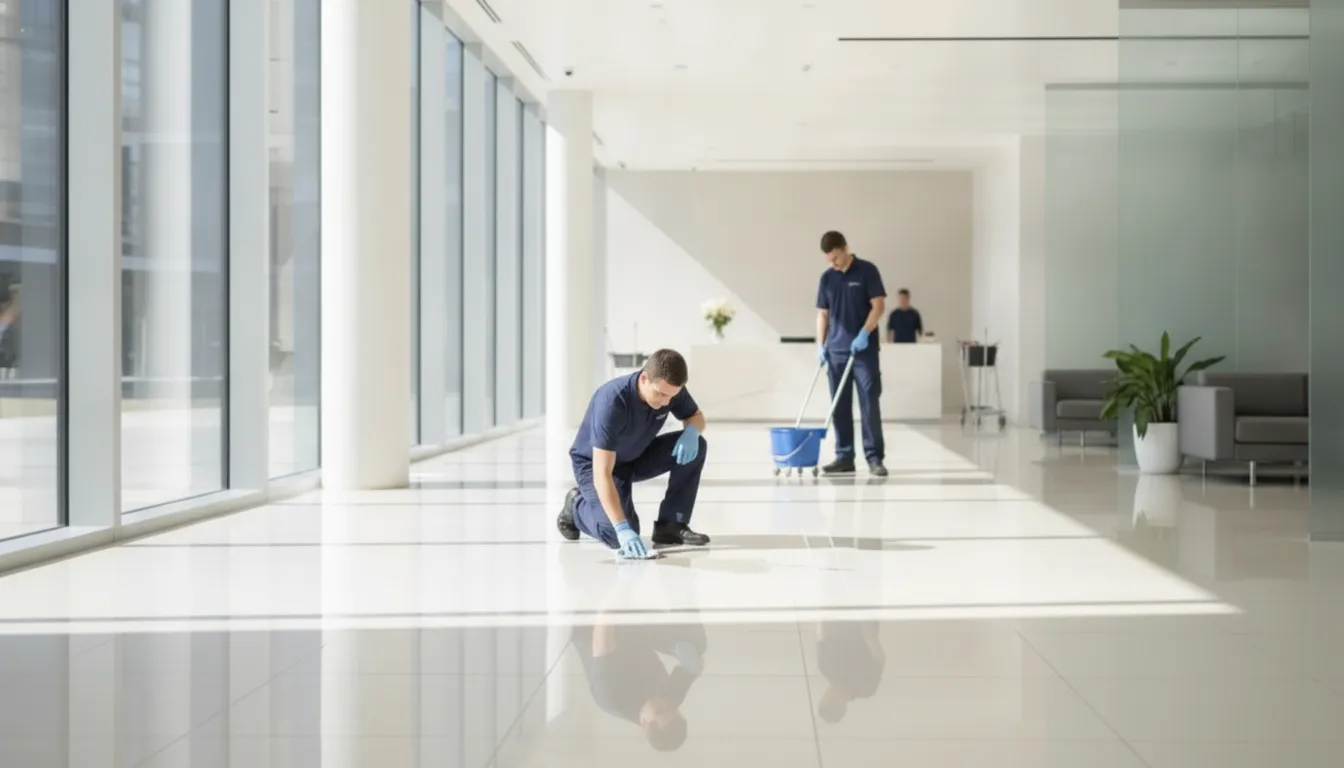
An urgent mess rarely arrives with a tidy scope attached. A lobby spill, dust after a repair, or a restroom that cannot wait all raise the same question. What should you tell a cleaner before you ask for help? Emergency commercial cleaning is a scoped conversation about an unplanned commercial need, not a promise that a crew will arrive in a set number of minutes. The useful first step is to name the building, what happened, which areas are affected, and the timing you want discussed.
Call (801) 500-4747 to request emergency cleaning help. Share the site, the work, and the timing you want discussed. You can also start from the homepage form.
What emergency commercial cleaning covers
For a facility manager, emergency commercial cleaning means cleaning that does not fit the next routine visit. It can be a one-time cleanup in an office, a warehouse aisle, a clinic corridor, a school hallway, a dealership showroom, or a customer area in a shop or restaurant. It can also be a sudden deep clean before people use a space again.
Janitor Utah is the public brand of Jani-Serv, Inc., a locally owned Utah commercial cleaning company. The commercial cleaning services page describes everyday janitorial care, construction cleanup, disinfection and deep cleaning, and specialist work such as floors, windows, and high dusting. An urgent request uses those same services. It does not open a separate menu with a published price or a guaranteed arrival window.
That distinction matters when you call or write. A routine plan is built around cadence: how often the space is cleaned and which tasks repeat. An urgent request is built around an event. You still need a scope. You just need it faster, and you should expect the conversation to start with the facts of the site rather than a flat rate.
A few situations belong in a different conversation, even when they feel urgent:
- Blood or other potentially infectious material is an employer safety issue first. OSHA's Bloodborne Pathogens standard, 29 CFR 1910.1030, applies when workers can be exposed to human blood or other potentially infectious materials, and it requires universal precautions. Your facility's exposure plan decides who may clean that material. A janitorial visit does not replace that duty. OSHA explains those worker protections.
- A planned construction cleanup, from cleaning during the build to a final cleanup, has its own scope. Use the construction cleanup page when the work follows a project, not a surprise.
- A scheduled turnover between tenants is a planning job. The tenant turnover cleaning guide covers that scope.
If the need is a commercial space in Utah and the work is cleaning, disinfection, or a one-time cleanup, the homepage form is the place to start the discussion. Say what you know. Leave the price and the schedule for the follow-up.
Facility managers often mix three jobs into one request. The first is the mess in front of them. The second is the routine plan they wish they already had. The third is a specialist task, such as floor care or glass, that they noticed only because the room is closed. Split those jobs in the note. The urgent area gets discussed first. The recurring plan and the specialist work can be quoted beside it, but they are not the same visit unless the scope says so.
What to confirm before you ask for help
A short note with the right details beats a long note that leaves the building unnamed. Use this list before you send the request. You do not need a perfect inventory. You do need enough for someone to tell whether a walkthrough or a scoped quote is the next step.
- Facility type and exact address. Say whether the site is an office, clinic, school, warehouse, dealership, shop, or restaurant, and give the street address. Serviceability is discussed from the address, not from a county name alone.
- What happened. Name the event in plain words: a spill, dust from a repair, a restroom failure, a one-time deep clean, or debris left in a working area. Skip drama. The condition of the space is what shapes the work.
- Areas and surfaces. List rooms, floors, or zones, and the materials involved. Carpet, hard floor, glass, restroom fixtures, and high ledges are not the same job.
- Who is still using the space. Say whether people are working, customers are present, or the area can be closed. Access changes the plan more than a clock time does.
- Requested timing. Give the window you want discussed, such as before opening or after the last shift. Requested timing is a preference. It is not a confirmation that the work can happen then.
- Product or safety limits. If the building specifies products, or if you want green-cleaning options discussed, say so. Green products are used whenever possible. They are not a guarantee on every surface.
- How to reach the person who can approve the scope. The quote form asks for a name, email, phone, site address, and type of work. A request does not confirm an appointment.
If you already have a recurring janitorial plan, say that too. Some urgent work can be discussed as an extra visit. Other work, including floors, windows, high dusting, and disinfection, is scoped on its own. The office and janitorial cleaning page is the home for the recurring plan, not for the one-time event.
Which details change the scope
Two buildings can share a headline and still need different work. Use the table to sort the note you send. Read each row as a prompt, not as a sentence. It is not a price list. It is also not a promise that every row is available at every site.
| What you report | Why it changes the conversation | What to leave for the quote |
|---|---|---|
| A small spill in one office or lobby. | The area may be limited, but the surface and nearby people still matter. | Name the room, the floor type, and whether the area can close. |
| A restroom or shared area that cannot wait. | Fixtures, traffic, and supply needs are part of the scope. | Name the rooms, and say whether supplies are already on site. |
| Dust or debris after a repair. | This can look like construction cleanup even when no build is underway. | Say where dust settled, and whether floors, glass, or fixtures are included. |
| A warehouse or industrial aisle. | Access, equipment, and open floor area change the plan. | Name the zone, any production limits, and the timing you want discussed. |
| A clinic, dental office, or school room. | Use, privacy, and product limits belong in the first note. | Name the rooms and any product rules the facility already has. |
| A request to disinfect surfaces. | Disinfection is discussed from areas, surfaces, and use, not from a kill claim. | Name the surfaces and any product the site already requires. |
Price follows that scope. Janitor Utah does not publish an hourly rate or a minimum for urgent work. The same is true of recurring cleaning: frequency, from a daily visit to a monthly visit, is set in the quote, not picked from a public package. If you want a sense of how recurring frequency is planned, read how often commercial buildings should be cleaned. That guide is about the ongoing plan. It does not set a response time for an urgent call.
Disinfection needs the same care with words. The disinfection page offers sanitation, disinfection, electrostatic disinfecting, and deep cleaning for commercial facilities. It asks you to describe areas, surfaces, and how the space is used. It does not claim a germ-free result, a medical certification, or an infection-control credential. Bring the product rules your building already has. Do not expect a visit to replace them.
How a Utah facility request gets scoped
Janitor Utah's public focus is commercial cleaning in Utah. The service-areas page names Salt Lake County, Utah County, Davis County, Summit County, and Tooele County as the commercial focus. An address outside those five counties can still be sent for discussion. Coverage is not assumed from a city name, and a marketing list is not a route sheet.
The homepage walkthrough is simple on purpose. You share the address and the type of work. Then you talk through surfaces, access, schedules, and product preferences. The scope comes after that conversation. About the company, the same idea shows up as three habits: a clear conversation, respect for the people using the building, and an agreement on who to contact.
For an urgent note, put the event in the type-of-work field and keep the rest specific. A useful note names the spill, the city, the floor, and the close time. One example is a lobby spill at a Provo office, on a hard floor, with the area able to close after 5 p.m. That version lets the follow-up discuss serviceability and timing. A note that only says "need someone now" does not.
Related work should stay linked, not blended:
- Industrial and warehouse space has its own page because access and floor area differ from a typical office. Start with industrial cleaning if the urgent area is a warehouse or plant, then still send the address.
- Medical and dental rooms raise privacy and product questions. The medical and dental cleaning page is the right background. It is not a certification claim.
- If you are comparing a long-term company rather than solving today's mess, use how to choose a commercial cleaning company. That article is about the ongoing relationship.
Supply restocking is for existing cleaning clients. Do not assume paper, soap, or other supplies are part of a one-time urgent visit unless the quote says so.
Walk the affected area once before you write, if it is safe to do so. Note the floor type, whether water or dust is still spreading, and which doors a crew would use. A photo can help the follow-up, but the address and the surface still have to be in the words. A picture of a wet lobby does not name the county, the product limits, or the person who can approve the work.
The public email on the site is info\@janiservut.com. The contact form is the clearer path because it already asks for the site address and the type of work. Use email if the form is not an option. Either way, include the same facts. Do not send a request that only says "as soon as possible" and a company name.
What a request does not confirm
Sending the form is the start of a conversation. The contact page says a request does not confirm an appointment. That line is easy to skip when a lobby is wet or a room needs to reopen. It is still the rule.
Nothing on the live site promises a same-day visit, a 24-hour crew, or a minute-based arrival. Older construction language about flexible scheduling is not an emergency dispatch promise either. If timing is tight, say the window you want discussed and the reason. The reply can then say whether that window can be talked through. It should not be treated as accepted until someone confirms the scope.
A few other limits keep the request honest:
- There is no online checkout and no instant fixed price.
- Bonding, insurance limits, and years in business are not claims this article makes.
- Church cleaning and kitchen hood or exhaust cleaning are not services to request here.
- Home cleaning and handyman work are not the offer.
- A testimonial on the site is not a verified review count, and an urgent visit is not proof of a medical outcome.
If the event involves blood or other potentially infectious material, follow the employer's exposure plan and OSHA's universal-precautions duty before you ask a cleaner to enter. Tell the cleaner what the material is. Do not ask a commercial cleaning visit to stand in for a regulated exposure response.
Call (801) 500-4747 or send the site and requested timing so the follow-up can discuss serviceability without treating the form as a booked visit.
Frequently asked questions
Does emergency commercial cleaning include a guaranteed arrival time?
No. You can share the timing you want discussed, such as before the building opens. A request does not confirm an appointment, and the site does not publish a response-time promise. Serviceability and timing are part of the follow-up.
What should I put in the quote form?
Include your name, email, phone, the site address, and the type of work. In the work description, add what happened, the areas and surfaces, who is still using the space, and any product limits. That is enough to start a scoped conversation.
Can an urgent cleanup include disinfection?
Disinfection and deep cleaning can be discussed for a commercial facility. Tell us the areas, surfaces, and how the space is used, plus any product the site requires. The visit is not a claim that a surface is germ-free or that the company holds a medical certification.
Which Utah counties are the commercial focus?
The service-areas page names Salt Lake, Utah, Davis, Summit, and Tooele counties. Send the exact address either way. A site elsewhere in Utah can be submitted for discussion, and the address decides the conversation.
Is a construction mess the same as an emergency clean?
Not always. Dust after a repair can be discussed as an urgent commercial cleaning need. A build that is underway, or a final cleanup at the end of a project, belongs on the construction cleanup scope. Say which one you have so the quote matches the work.